Produttore di quadri elettrici (nome coperto da NDA) · Quadri elettrici di bassa tensione · Italia
2 giorni
per un preventivo con i prezzi, invece di circa 10
Preventivi fatti a mano. Poi non più.
3 settimane
SbloccareVedere l’azienda

Sbloccare
Four Danish manufacturers went from weeks to hours. None of them started by buying software.
Gli articoli sono disponibili solo in inglese.
A manufacturer of low-voltage electrical panels came to us with one sentence: could we help unload the director and the engineer? A priced quote took about ten days. Nobody could say exactly where the days went.
This is the most common sentence we hear from manufacturers. It is also one of the best-studied problems in industrial engineering. Researchers at the Technical University of Denmark and the University of Southern Denmark have measured what happens to quoting time when a company writes its rules down and puts them in a system. The numbers are worth knowing before you spend anything.
Nobody spends ten days working on a quote. The quote spends ten days waiting. In a typical make-to-order company the path looks like this:
Every step is short. Every handover is long. And every handover waits for one of two people.
The Danish researchers followed companies that put their product and pricing rules into a configuration system built for their own products. The results are consistent.
85.5%
In four companies studied in detail (Hvam et al., 2013):
Grundfos, the pump manufacturer, cut quoting time from 9.5 days to 3.4 and the hours spent on it by 75% (Kristjansdottir et al., 2018). A small Italian mould maker went from five or six days to one, according to Forza and Salvador, cited in the same DTU study.
The interesting part is not the software. In every case the work started with the rules. Which component goes with which. Which substitutions are allowed. How the price is built. Who approves what. The system came second and simply ran those rules the same way every time.
The researchers are honest that the product often changed along the way. Writing the rules down showed which variants made no sense, and engineers simplified them. That is work, and it is done together with the engineers, not around them.
One Danish company ran five configurator projects. Three paid for themselves within 12 to 32 months. Two had not paid back after five years (SDU). The reason was not the technology. The tools did not cover the real cases salespeople handled, so they went back to Excel.
Grundfos saved time, but the researchers found no reliable evidence that sales grew because of it. Across the Danish projects, 71 to 91% of the benefit was saved resources, not new orders.
So a faster quote is not a promise of more revenue. It is a promise of fewer hours, fewer unanswered requests and a company that keeps quoting when one person is away. That is usually enough.
We did not start with the feature they asked for. We started with the structure.
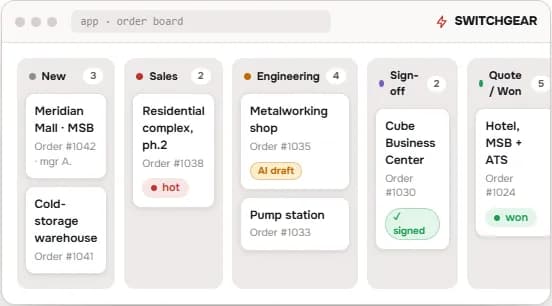
The price list became a catalogue of 1,887 items in 223 analog groups, each with a risk flag that says where a cheaper alternative is fine and where it isn't. The pricing formula — materials, assembly coefficient, cost, markup, VAT — moved out of the director's head and into the system, with the coefficient and markup set per brand by the manager. Orders move across a board from New to Won, and each role sees only its stage. The engineer never sees the margin.
Incoming PDF and DWG drawings are read by a drawing assistant that drafts the panel contents against the catalogue and prices the draft. Every proposed line carries a reason and a reference to the sheet it came from. The engineer confirms each line before anything reaches the client.
Three weeks from idea to production. A priced quote now takes about two days instead of ten. The full story is in Quoted by hand. Then not.
Calcolatore dei costi
If the answers make you uncomfortable, the problem is structural, and it is solvable. The rules exist. They are just not written down yet.
Related: When the engineer is on holiday, the company stops quoting · CPQ software or a custom quoting system?
Produttore di quadri elettrici (nome coperto da NDA) · Quadri elettrici di bassa tensione · Italia
2 giorni
per un preventivo con i prezzi, invece di circa 10
3 settimane
Tutto aspetta una sola persona.
Trenta minuti. Voi descrivete il problema e il risultato che volete. Noi facciamo domande. Se possiamo aiutarvi, ricevete una email con cosa abbiamo trovato, cosa costruiremmo e quanto costa. Se non possiamo, ve lo diciamo.
Non siete pronti a parlarne? Scoprite quanto vi costa il modo in cui lavorate oggi