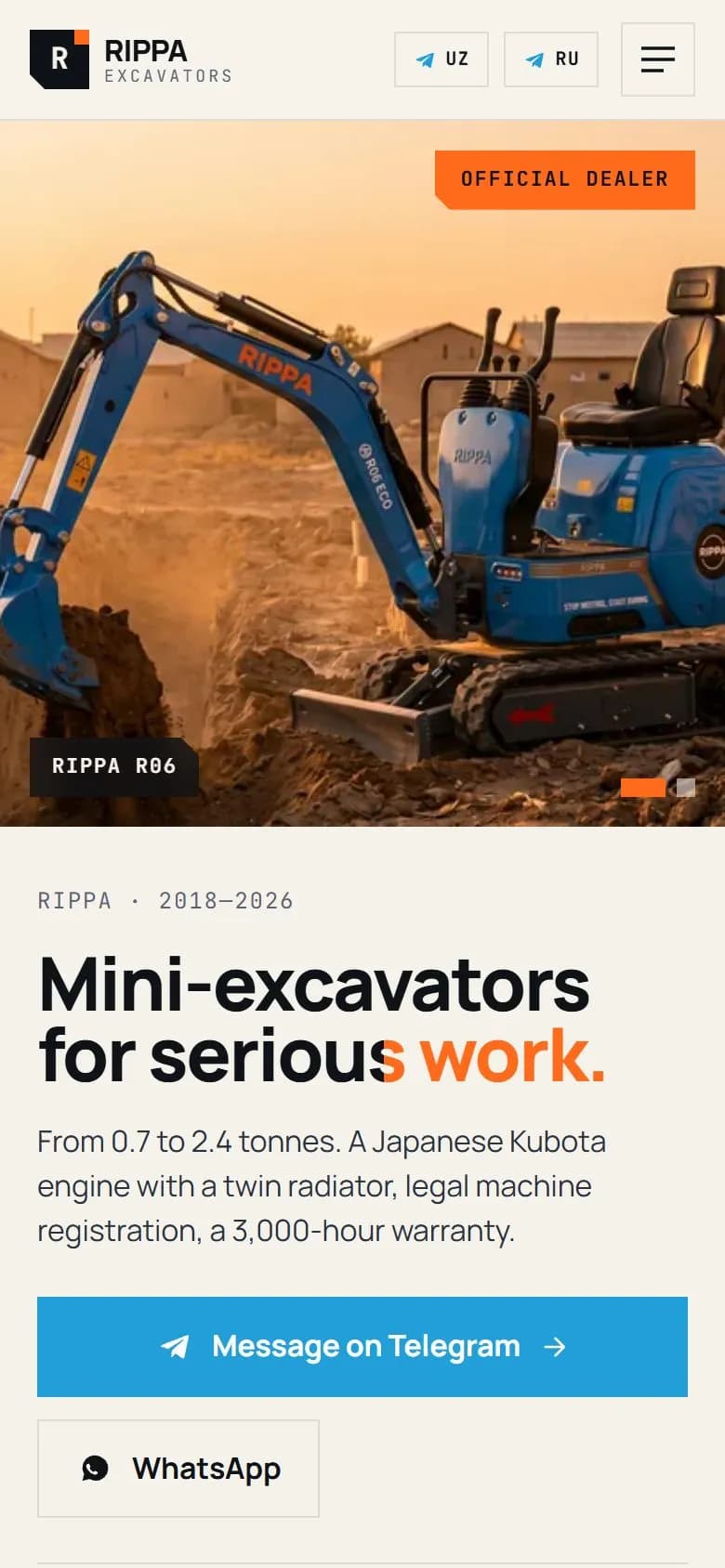
Rippa · Mini-excavators, dealer storefront · Central Asia
57,494
owner messages turned into 60 articles buyers trust
Nobody trusts a dealer's brochure. They trust other owners.
5–6 weeks
More salesShape the market

More sales
Buyers don't believe brochures. They believe other owners. A dealer's community chat turned out to be its best sales asset.
A buyer about to spend $6,700 or more on a machine they have never seen has questions. Which model fits my jobs? What breaks? What does it cost to run? Can I register it? How do I haul it? A dealer's brochure answers none of them, and the buyer knows not to trust it anyway.
Rippa, a dealer of mini-excavators, had the answers. They were sitting in its owners' Telegram group: eight months of conversations, 383 owners, 57,494 messages. Nobody had turned them into a website.
This isn't a hunch.
65% vs 42%
Any dealer can list horsepower. Very few can show eight months of real ownership in the owners' own words, with names and dates attached.
We obtained the full export of the group: 57,494 messages, 4,158 photos of machines at work and 1,085 field videos.
The result: 60 articles in eight categories, chosen because they map to the questions a buyer asks before calling the dealer. Which model. Registration, including a documented case with the Uzbek authorities. Haulage, with the 750 kg trailer limit spelled out. Running costs: oil, filters, the first service and what the factory usually doesn't fill. Earning: what to charge per hour or per shift. Trust: how to tell a genuine machine from a clone.
A buyer can now do their due diligence on the site. The full story is in Nobody trusts a dealer's brochure. They trust other owners.
Research on B2B peer-help communities found that 1 to 2% of members produce 40 to 60% of the content (Bone et al., Journal of Service Research, 2015). In practice, a few hundred active owners are enough. The work is finding the threads where those few people answered the questions everyone else was asking.
The same study found that customers who ask and answer questions in a community contact support less often. It also found that heavy, broad participation goes with more support contacts, not fewer. Engaged customers are engaged everywhere. Measure a community by what it does for buyers, not only by tickets saved.
Many manufacturers and dealers do: a WhatsApp group of installers, a Telegram channel of owners, a forum nobody reads in full. Before you publish anything:
Cost calculator
A competitor can copy your product page in an afternoon. It cannot copy eight months of your customers talking about your machines. The community is the asset. The website is how buyers finally get to see it.
Related: Your loyalty programme is not why contractors buy from you · What a phone order really costs a manufacturer
Rippa · Mini-excavators, dealer storefront · Central Asia
57,494
owner messages turned into 60 articles buyers trust
5–6 weeks
The same request. Very different answers.
Thirty minutes. You describe the pain and the result you want. We ask questions. If we can help, you get one email with what we found, what we'd build and what it costs. If we can't, we'll say so.