Alfakom Learning Center · Education · International
3 → 1
three Telegram bots replaced by one app
The criteria were in the teacher's head. That was the problem.
2 weeks
Unblock

Run it yourself
Automated checking fails when the criteria aren't written down. Write them first, and the rest takes two weeks.
A learning centre ran homework review through three Telegram bots. Students submitted work, the bots routed it, a teacher checked it by hand and grades ended up in a Google Sheets file. It worked, after a fashion. The brief was to replace the bots with something better.
Before writing any code, we read the entire course.
There was no list of assignments. There were no written evaluation criteria. The requirements for each submission existed inside the course content and inside the teacher's experience, and nowhere else. The teacher knew what a good presentation looked like. The bots didn't.
That is why review took so much manual work. Without explicit criteria, the only person who could assess a submission was the person who already knew what to look for.
8.2 h
The survey of 502 UK teachers was commissioned by an assessment software company, so treat the figures as an industry estimate. More than half had considered leaving teaching in the previous year because of marking workload.
Speed matters for students too. Feedback that is timely and regular adds, on average, six months of progress over a year (Education Endowment Foundation). A submission that waits a week for review loses most of that.
We extracted 14 assignments from the course — 11 homeworks, 2 exams and a project — and turned each one into a structured specification.
Only then did we build anything.
The student opens the app and sees the active assignment, the deadline and one button. They can submit text, a photo, a video, slides or a document, and shoot directly from the camera in the app. They are released immediately while review runs in the background.
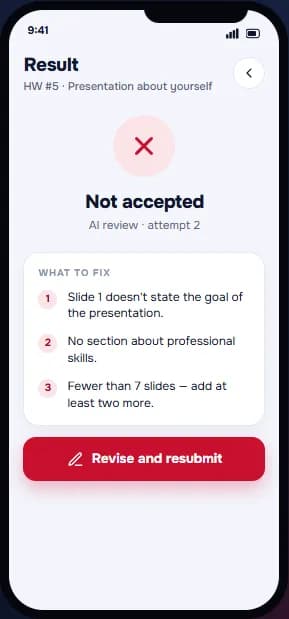
If the work is rejected, the student gets a numbered list of specific things to fix, each tied to the criterion it fails. Not a vague score. Item one, item two, item three. The student revises and resubmits.
A feed of incoming work with the review result already attached: accepted, rejected or flagged for attention. The teacher looks at the submission and gives the final grade. They can send work back with a comment or override the automated review. For assignments that don't suit automatic checking, the review step is skipped.
Work that doesn't need a specialist's judgment doesn't reach the teacher. Work that does arrives with the context prepared. Twice a day the system posts a class summary to Telegram: how many have submitted, how many are revising, how many haven't started.
Each student sees their position, their score and the gap to the top. Classmates appear as animals: a panda, a hedgehog, a fox. Each student sees a different set of masks, so the class can't compare screens to work out who is falling behind. The gap stays visible. The names don't.
Three bots replaced by one app, running on Android, iOS and the web from a single codebase. 34 students in production. About two weeks from the first conversation to a working system. The full story is in The criteria were in the teacher's head. That was the problem.
Cost calculator
If you can, the system is the easy part. If you can't, that is the work to do first, with or without software.
Related: When the engineer is on holiday, the company stops quoting · The owner's week
Alfakom Learning Center · Education · International
3 → 1
three Telegram bots replaced by one app
2 weeks
You run it by hand, and you're the bottleneck.
Thirty minutes. You describe the pain and the result you want. We ask questions. If we can help, you get one email with what we found, what we'd build and what it costs. If we can't, we'll say so.