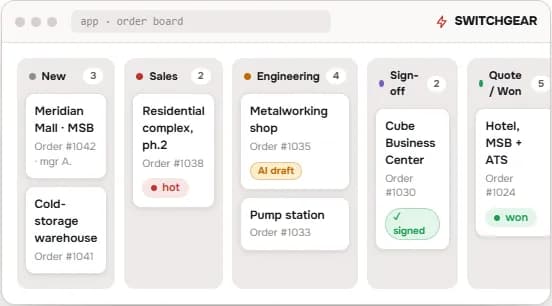
Switchgear manufacturer (name under NDA) · Low-voltage electrical panels · Italy
2 days
to a priced quote, instead of about 10
Quoted by hand. Then not.
3 weeks
UnblockSee the business

Unblock
Key-person dependency is not a staffing problem. It is a structure problem, and it has a test.
Every manufacturer we talk to has one. The engineer who knows which component fits, which analog is safe and what the job really costs. When that engineer goes on holiday for two weeks, the company does not stop working. It stops quoting.
The usual response is to hire a second engineer. That rarely works. The second engineer has to learn the same rules from the first, and the rules are not written anywhere. You end up with two people holding the same fragile knowledge, and twice the payroll.
When we looked at the panel maker described in Quoted by hand. Then not., the engineer's workload was not the real problem. There was no system at all. The engineer's knowledge, the director's judgment and the pricing logic that made the business work were locked inside two people's heads. Any feature added on top of that would have produced a more sophisticated version of the same fragility.
The same pattern shows up far outside manufacturing. A learning centre we worked with had three Telegram bots for homework review. The bots routed submissions, but only the teacher could assess them, because the evaluation criteria existed nowhere except in the course content and the teacher's experience. A music school had a CRM, but the director rescheduled every lesson personally.
Different industries. Same structure: one person is the system.
There is no clean official statistic on key-person dependency, but the signals are consistent.
The most telling example comes from the UK government's Made Smarter programme. Its independent evaluation describes a company that sharply cut back its digital plans after a key employee left and took their informal knowledge with them (Ipsos for DBT, 2025).
2 of 5
Answer these five questions about the person your business depends on most.
If two or more answers are "everything", "nobody" or "months", you have a structural dependency.
You do not need to document the whole business. Start with the rules that block the most work.
The criteria. For the learning centre, we read the entire course and extracted 14 assignments into structured specifications. Every criterion is tagged as required or optional. Every rejection reason is written in plain language a student can act on. Only then did we build the app. The story is in The criteria were in the teacher's head.
The formula. For the panel maker, the pricing formula — materials, assembly coefficient, cost, markup, VAT — went into the system. The manager sets the coefficient and markup per brand. The formula produces the same result every time for the same inputs.
The catalogue. An 85 MB price list became 1,887 items in 223 analog groups, each with a risk flag. The engineer's judgment about where a cheaper part is fine became visible to everyone who needs it.
The roles. Each role sees and edits only what belongs to it at each stage. Every handover is logged, and every "send back for rework" requires a written comment.
Writing rules down does not remove the expert. It removes the reading, the looking up and the retyping. In the panel maker's system, a drawing assistant drafts the panel contents from PDF and DWG files, and every line carries a reason and a reference to the drawing sheet. The engineer confirms each line. Nothing goes to a client unchecked.
The result: the engineer reviews instead of reading, the director sees the pipeline without asking anyone, and the company keeps quoting when someone takes a holiday.
Cost calculator
Related: Why your quotes take ten days · Homework review that doesn't need the teacher's head
Switchgear manufacturer (name under NDA) · Low-voltage electrical panels · Italy
2 days
to a priced quote, instead of about 10
3 weeks
Everything waits for one person.
Thirty minutes. You describe the pain and the result you want. We ask questions. If we can help, you get one email with what we found, what we'd build and what it costs. If we can't, we'll say so.