Talents Music School · Music education · Minneapolis, USA
0
manual payment calculations across 2 locations
They asked for a payment button. We looked at what they actually had.
Run it yourselfUnblock

Run it yourself
Empty chairs cost money. Reschedules cost the director's time. Both are measurable, and both shrink with the right setup.
Every school knows it loses lessons to no-shows and loses hours to reschedules. Very few count either. They feel like the cost of doing business. They are costs you can measure, and they respond to fairly simple changes.
Take a school that runs 300 lessons a month at €30 each, with a 10% no-show rate.
If your policy charges for missed lessons, the money may be covered, but the slot isn't, and someone spends time chasing the payment and explaining the policy.
The evidence here is unusually strong for a small-business question, because it comes from healthcare, where no-shows have been studied in randomised trials.
1.48×
At a 10% no-show rate, odds of 1.48 bring no-shows down to roughly 7%. Our cost calculator assumes less: a 25% reduction, to 7.5%. In the example above, that recovers about €2,700 a year. It's not a fortune. It's also not the bigger cost.
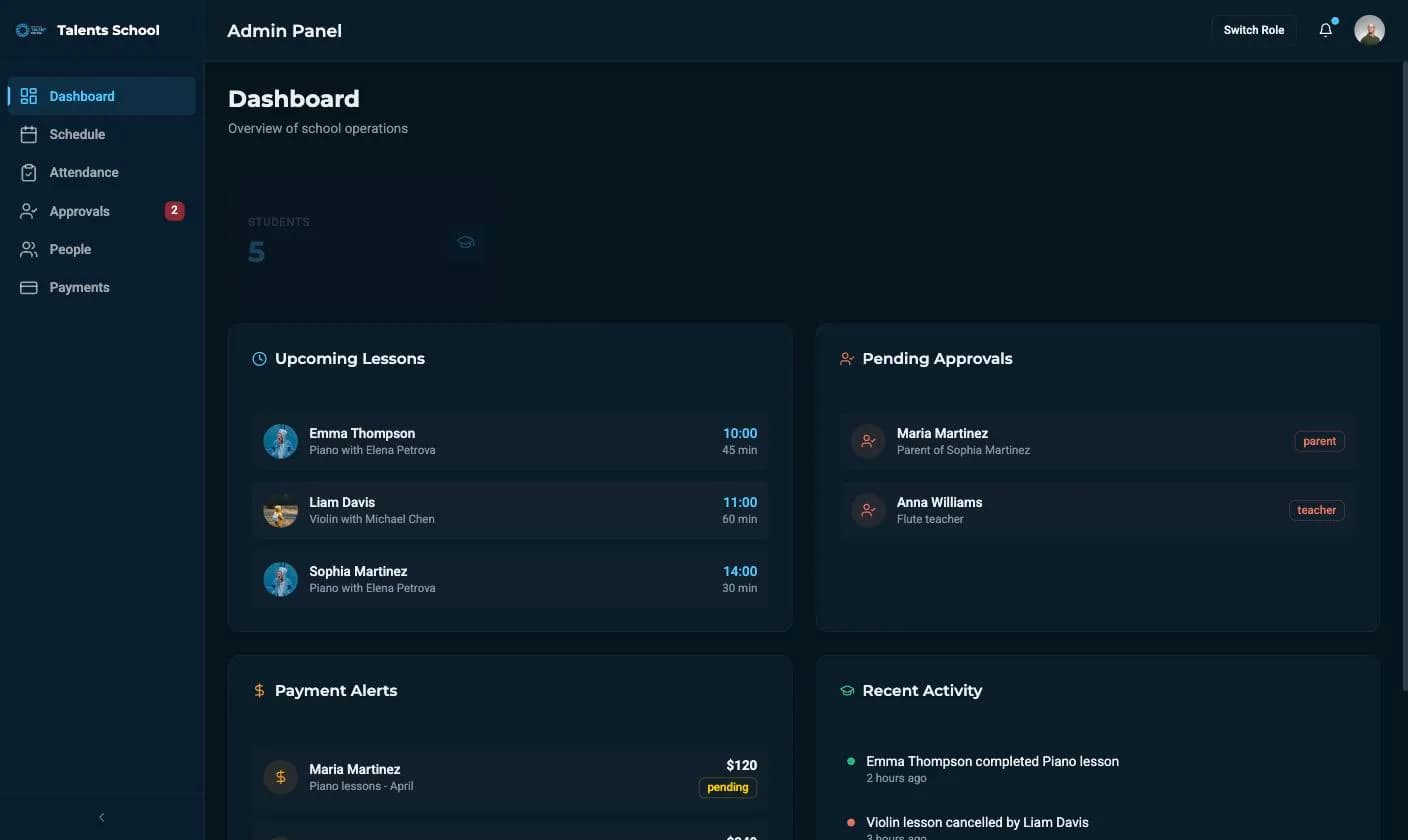
In the music school from our portfolio, 80% of lessons are private. Private lessons move constantly. Before the new system, a reschedule went like this:
Four messages, and the director is in every one. Forty reschedules a month means 160 messages, each one an interruption.
After:
The lesson appears in the parent's and the teacher's calendars at the same time. Nobody forwards anything. That change, together with teacher-managed schedules and automatic payment tracking, is why the director now spends at least a third less time on admin, sometimes half.
Self-service is not automatically less work. When one company opened an online self-service portal, calls to its call centre went up by 14%, because customers became more active (Kumar and Telang, ISR 2012). An app that lets parents request anything at any time can create more requests, not fewer.
The fix is in the design:
Cost calculator
Before you change anything, write down:
If the answer to the third question is you, that is where to start.
Related: Why we said no to the payment button · The owner's week: where 40% of it goes
Talents Music School · Music education · Minneapolis, USA
0
manual payment calculations across 2 locations
You run it by hand, and you're the bottleneck.
Thirty minutes. You describe the pain and the result you want. We ask questions. If we can help, you get one email with what we found, what we'd build and what it costs. If we can't, we'll say so.