Talents Music School · Music education · Minneapolis, USA
0
manual payment calculations across 2 locations
They asked for a payment button. We looked at what they actually had.
Run it yourselfUnblock

Run it yourself
A music school asked for online payments. The problem was underneath. What we built, and what the director got back.
A music school in Minneapolis came to us with a simple request: add online payments to the website. Reasonable. Most schools do their accounting in a mix of spreadsheets and memory, and online payment feels like the obvious first step.
We said we'd take a look first.
The school ran on an off-the-shelf CRM built for something like a gym or a clinic: fixed schedules, regular payments, few cancellations. A music school is the opposite. Most lessons are private, one-on-one, and the schedule moves all the time — reschedules, extra sessions, cancellations, teachers changing their availability.
The platform couldn't handle any of that, so the director did it by hand: filled in the teachers' schedules, agreed every student's lesson times, took every reschedule request and told the teacher separately, reconciled payments and passed them to the accountant.
A payment button would have added one more thing to check. The problem wasn't payments. It was that every process ran through one person.
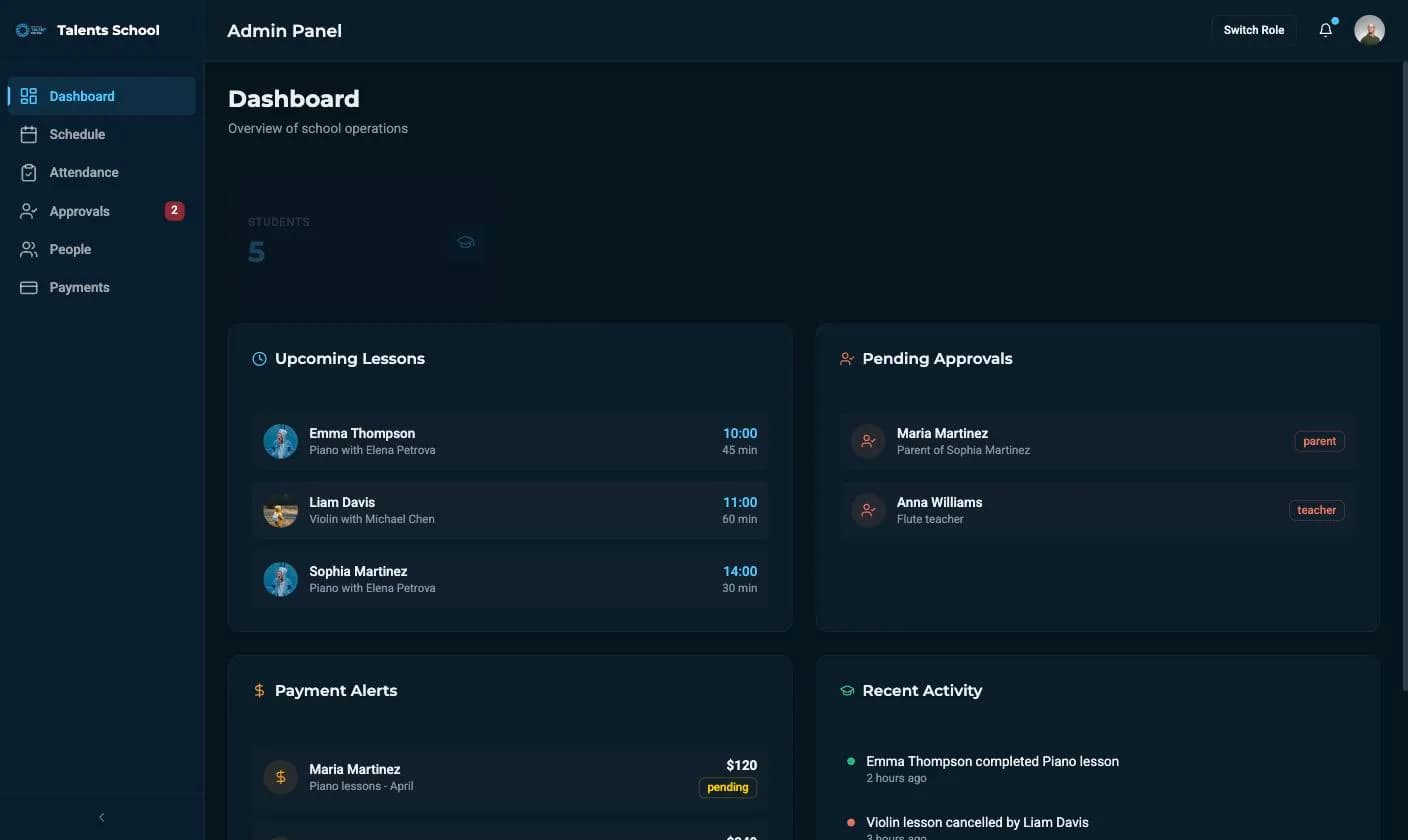
A system designed around the school's actual processes, not the assumptions of an appointment platform.
Built on Directus, so the school can add a field, a report or a third location without switching platforms.
These are the director's own numbers, before and after.
| Before | After | |
|---|---|---|
| Teacher schedules | Filled in by the director | Filled in by teachers, approved by the director |
| Student schedules (80% private lessons) | Agreed by the director | Agreed between teachers and students in the app; the director checks lessons match payments |
| Payments | Reconciled and passed on by hand | Arrive automatically, with a copy to the accountant |
| Reschedules | Director takes the request and tells the teacher | Parent requests, teacher and administrator confirm in the app |
| Director's time on admin and messages | 100% | At least a third less, sometimes half |
| Locations | One | A second location opened, with more students |
| Evenings | Work continued at home | Work stays at work |
⅓ to ½
Across Europe, 55% of small-business owners spend more than 40% of their time on administration (Visma and Kantar, 2024). The same survey found that 46% put growth first and only 13% put efficiency first.
That matches what happened here. The freed hours didn't go into rest. They went into a second location.
If you are the person every request passes through, a single feature won't change that. Three questions tell you where to start:
Cost calculator
The full project is in They asked for a payment button. We looked at what they actually had.
Related: The owner's week: where 40% of it goes · Missed lessons and moved lessons
Talents Music School · Music education · Minneapolis, USA
0
manual payment calculations across 2 locations
You run it by hand, and you're the bottleneck.
Thirty minutes. You describe the pain and the result you want. We ask questions. If we can help, you get one email with what we found, what we'd build and what it costs. If we can't, we'll say so.