
Switchgear manufacturer (name under NDA) · Low-voltage electrical panels · Italy · 2026
Quoted by hand. Then not.
- Timeline
- 3 weeks
- Market
- Italy
2 days
to a priced quote, instead of about 10
What was missing
A manufacturer of low-voltage electrical panels came to us with one sentence: could we help unload the director and the engineer? No spec, no data model. Just a hunch and a problem they couldn't quite name.
We spent time on it before we agreed on anything.
The insight
The real problem wasn't the engineer's workload. It was that there was no system at all, which meant the engineer's knowledge, the director's judgment, and the pricing logic that made the business work were all locked inside two people's heads. If either of them was unavailable, nothing moved. That's not a staffing problem. That's a structural one, and adding any feature on top of it, including the one they asked for, would have produced a more sophisticated version of the same fragility.
We didn't start with the feature. We started with the structure.
What we built
The order pipeline
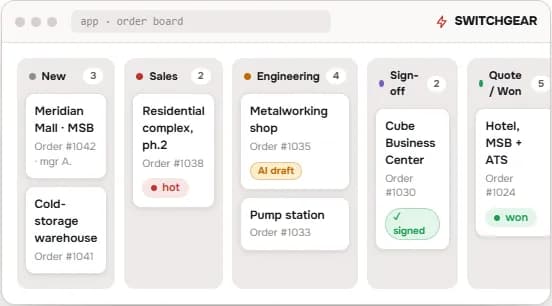
We built a kanban-style order board where every order moves through stages: New, Sales, Engineering, Sign-off, Quote, Won. Each role sees and can edit only what belongs to them at that stage. The manager opens and progresses the order. The engineer builds the panel contents, but only while the order is in Engineering. The head of sales and director handle pricing and approval. Money is visible only to the manager, head of sales, and director. The engineer never sees the margin.
Every stage change is logged. Every "send back for rework" requires a written comment. Nothing disappears and nothing is assumed.
The catalog
The client had an 85 MB price list: 20 sheets, hundreds of images, no structure. We imported it into a catalog of 1,887 items, organised into 223 analog groups by function, type, poles, rating, and breaking capacity. Each category carries a risk flag: where a cheaper alternative is fine, and where it isn't. The price difference between analogs is visible right in the component card. The engineer can see options and make an informed choice. The system remembers which components appear most often and surfaces that usage data.
Pricing
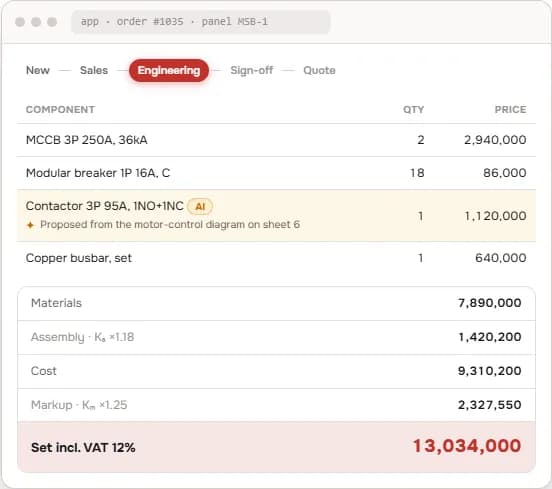
The pricing formula runs transparently through every order: materials, assembly coefficient, cost, markup, VAT. The assembly coefficient and markup are set by the manager, per manufacturer brand. The engineer doesn't set prices. The formula isn't in anyone's head anymore. It's in the system, it runs automatically, and it produces the same result every time for the same inputs.
The AI drawing assistant
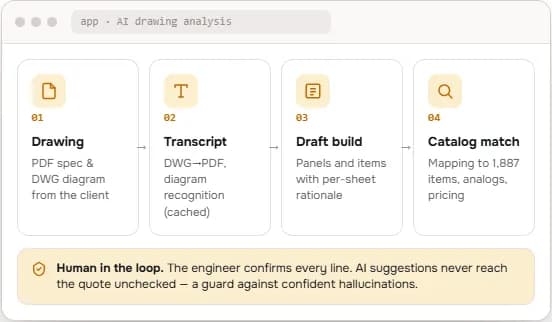
Clients send PDF specifications and DWG diagrams. The system converts the DWG files to PDF, reads the drawings, drafts the panel contents against the catalog, matches components by specification and analog, and prices the draft automatically. Every line the system proposes is tagged with a rationale and a reference to the drawing sheet it came from. The engineer reviews each line and confirms it before it reaches the quote. Nothing goes to a client unchecked. The system drafts; the engineer decides.
The prompts that guide the drawing analysis are editable by the director in the admin panel. The business can adjust how the system works without calling a developer.
The documents
Every completed order produces two documents on a branded template. The Quote shows panels, quantities, prices, and totals with VAT. The Specification shows equipment with brands but no prices, formatted for procurement. Both export to Excel and print to PDF. Every quote generation is saved to history, so previous versions don't disappear when a new one is issued.
The director's dashboard
Before this system existed, the director had no view of the pipeline. Now there's a dedicated screen: revenue by month, the funnel with amounts at each stage, average deal size, conversion rate, time to quote, and a list of orders that have been sitting in one stage for more than 14 days, each one clickable. Top managers by volume. Usage statistics for the drawing assistant. The director can see the business without asking anyone what's in it.
The CRM nobody asked for
Once the quoting system was running, we saw what else was slowing the office down and added CRM functions to the same platform. The company already had a CRM. The team moved to the new system on their own, because it was easier to work in.
How we worked
We built this in three weeks. The first week was the database schema, the pricing core, the order API, and the frontend skeleton with roles and the board. The second week was the full catalog with analogs and risk flags, per-brand markup, panel templates, and the Quote and Specification documents. The third week was the drawing assistant, real login with passwords and sessions, editable role permissions, the dashboard, signed file links, and deployment on the client's own server.
It runs on Ubuntu with nginx and systemd. The client's customers receive real documents from a working production system.
Results
3 weeks from idea to a working system in production. 1,887 catalog items imported from an 85 MB price list. 25 database migrations, 11 API modules, a tested pricing core. 4 roles with separate permissions and calibrated money visibility.
Manual quoting is gone. The director sees the pipeline. The engineer reviews rather than reads. Quotes go out on a branded template with version history. The pricing logic that used to live in one person's head now runs automatically and consistently every time an order moves through the system.
What the work included
Custom software development, order pipeline architecture, product catalog build, pricing logic, document generation, AI drawing analysis, deployment
Stack
Tell us what's missing.
Thirty minutes. You describe the pain and the result you want. We ask questions. If we can help, you get one email with what we found, what we'd build and what it costs. If we can't, we'll say so.