Talents Music School · Formazione musicale · Minneapolis, USA
0
calcoli manuali dei pagamenti in 2 sedi
Hanno chiesto un pulsante di pagamento. Noi abbiamo guardato cosa avevano davvero.
Gestire da soliSbloccare

Gestire da soli
A music school asked for online payments. The problem was underneath. What we built, and what the director got back.
Gli articoli sono disponibili solo in inglese.
A music school in Minneapolis came to us with a simple request: add online payments to the website. Reasonable. Most schools do their accounting in a mix of spreadsheets and memory, and online payment feels like the obvious first step.
We said we'd take a look first.
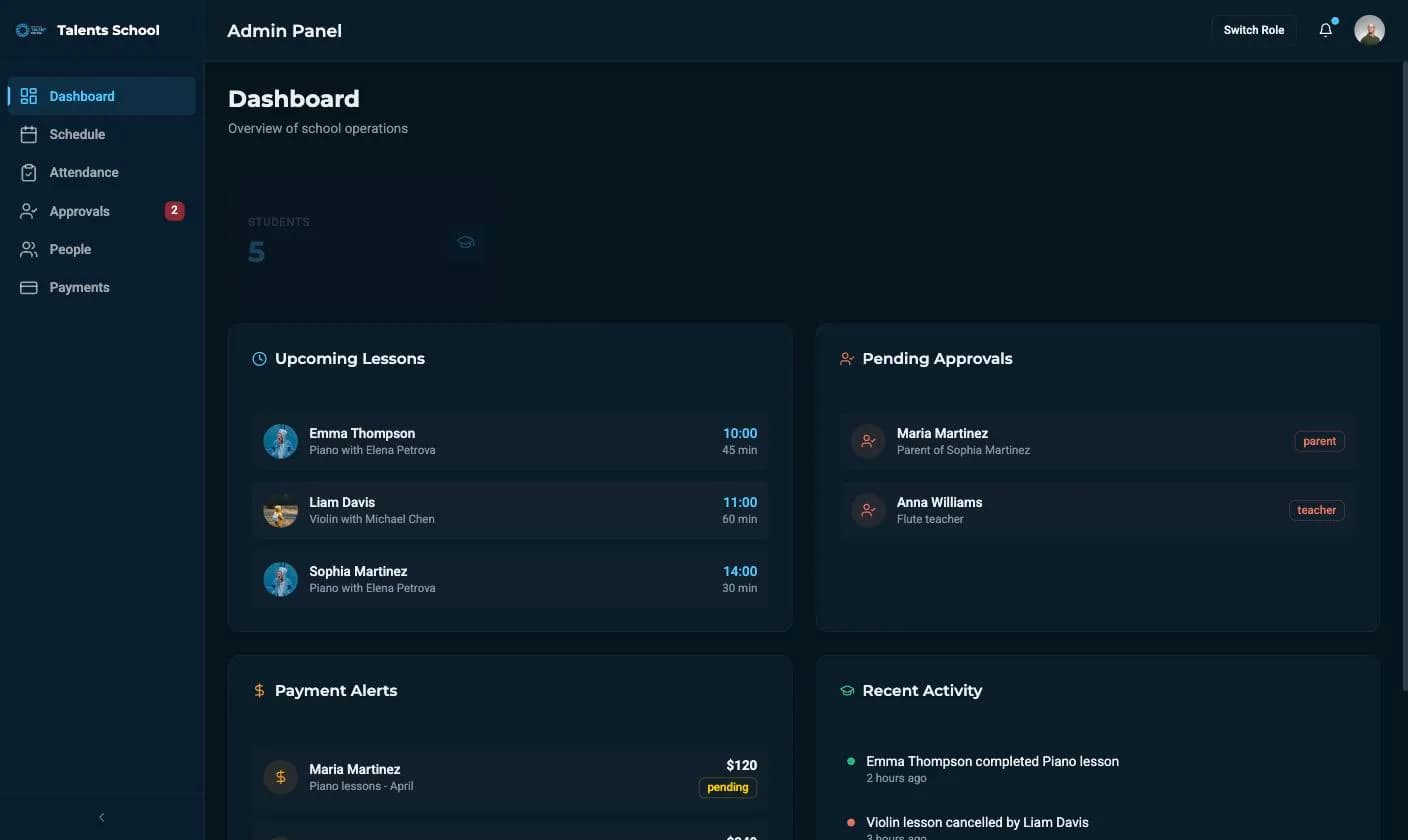
The school ran on an off-the-shelf CRM built for something like a gym or a clinic: fixed schedules, regular payments, few cancellations. A music school is the opposite. Most lessons are private, one-on-one, and the schedule moves all the time — reschedules, extra sessions, cancellations, teachers changing their availability.
The platform couldn't handle any of that, so the director did it by hand: filled in the teachers' schedules, agreed every student's lesson times, took every reschedule request and told the teacher separately, reconciled payments and passed them to the accountant.
A payment button would have added one more thing to check. The problem wasn't payments. It was that every process ran through one person.
A system designed around the school's actual processes, not the assumptions of an appointment platform.
Built on Directus, so the school can add a field, a report or a third location without switching platforms.
These are the director's own numbers, before and after.
| Before | After | |
|---|---|---|
| Teacher schedules | Filled in by the director | Filled in by teachers, approved by the director |
| Student schedules (80% private lessons) | Agreed by the director | Agreed between teachers and students in the app; the director checks lessons match payments |
| Payments | Reconciled and passed on by hand | Arrive automatically, with a copy to the accountant |
| Reschedules | Director takes the request and tells the teacher | Parent requests, teacher and administrator confirm in the app |
| Director's time on admin and messages | 100% | At least a third less, sometimes half |
| Locations | One | A second location opened, with more students |
| Evenings | Work continued at home | Work stays at work |
⅓ to ½
Across Europe, 55% of small-business owners spend more than 40% of their time on administration (Visma and Kantar, 2024). The same survey found that 46% put growth first and only 13% put efficiency first.
That matches what happened here. The freed hours didn't go into rest. They went into a second location.
If you are the person every request passes through, a single feature won't change that. Three questions tell you where to start:
Calcolatore dei costi
The full project is in They asked for a payment button. We looked at what they actually had.
Related: The owner's week: where 40% of it goes · Missed lessons and moved lessons
Talents Music School · Formazione musicale · Minneapolis, USA
0
calcoli manuali dei pagamenti in 2 sedi
Gestite tutto a mano, e il collo di bottiglia siete voi.
Trenta minuti. Voi descrivete il problema e il risultato che volete. Noi facciamo domande. Se possiamo aiutarvi, ricevete una email con cosa abbiamo trovato, cosa costruiremmo e quanto costa. Se non possiamo, ve lo diciamo.
Non siete pronti a parlarne? Scoprite quanto vi costa il modo in cui lavorate oggi