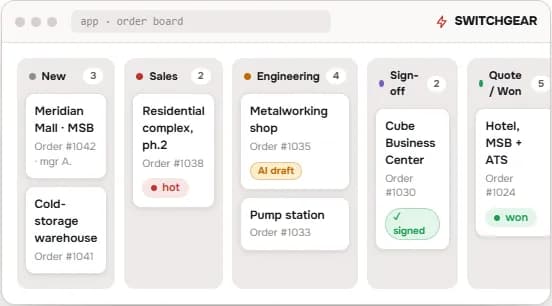
Switchgear manufacturer (name under NDA) · Low-voltage electrical panels · Italy
2 days
to a priced quote, instead of about 10
Quoted by hand. Then not.
3 weeks
UnblockSee the business

Unblock
When a box is the right answer, when it isn't, and why two of five configurator projects in one study never paid back.
If your quotes take days, someone will sell you CPQ. Configure, price, quote: a salesperson picks options, the software prices them and prints the document. For many companies that is exactly the right answer, and we say so on the first call.
For others, it becomes an expensive tool next to the spreadsheet that still does the real work. The difference is not the size of the company. It is how standard your process is.
The best evidence comes from Danish universities that have followed configurator projects for over a decade. In 12 of 14 engineering companies, quote preparation time fell by 75 to 99.9%, by 85.5% on average (Haug, Hvam, Mortensen, 2011). Person-hours fell by 78.8%.
Those numbers are real. But the same research group published the other side too.
3 of 5
The two failures had the same cause. The tool did not cover the cases salespeople actually handled. They used it for the easy quotes and went back to Excel for the rest. The software worked. It just described a different business.
Answer yes or no.
Five or more yes answers: buy a box. The process is standard enough, and you will be live faster.
Three or fewer: the process is yours, not the vendor's. A box will force you to change how you sell, or it will be bypassed.
The panel maker in Quoted by hand. Then not. answered no to most of these.
None of this is unusual. It is how most make-to-order companies work. A CPQ built for configurable products has nowhere to put "this analog is fine for this circuit but not for that one".
We built a catalogue of 1,887 items in 223 analog groups with a risk flag on each category, a per-brand pricing formula, roles with calibrated visibility of money and a drawing assistant that drafts from the client's files. Three weeks to production. The engineer reviews instead of reading.
The benefit is mostly hours, not sales. In the Danish projects, 71 to 91% of the measured benefit was saved resources. Grundfos saved 75% of quoting hours, but researchers found no reliable proof that sales grew because of it (Kristjansdottir et al., 2018). Count the hours and the requests you can finally answer. Don't count on revenue.
Running costs matter more than build costs. Operations and support take 60 to 80% of the lifetime cost of software (arXiv, 2026). Whoever builds it should keep supporting it, and you should own the code and the data.
Writing the rules is real work. In the DTU cases the product itself often changed while the rules were written down. Engineers have to be in the room from the first week.
The average company leaves 36% of its SaaS licences unused, according to a vendor study (Zylo, 2026). A quoting tool your team bypasses is not cheap because the subscription is low. It is expensive because you pay for it and still pay the engineer to do the work by hand.
Cost calculator
Run the seven questions with the person who quotes most often, not with the person who signs the budget. Their answers decide whether a box will be used. If the answer is a box, buy it. If it isn't, the rules your engineer carries are the asset. Write them down before you choose any software.
Related: Why your quotes take ten days · Build or buy? A checklist for mid-sized companies
Switchgear manufacturer (name under NDA) · Low-voltage electrical panels · Italy
2 days
to a priced quote, instead of about 10
3 weeks
Everything waits for one person.
Thirty minutes. You describe the pain and the result you want. We ask questions. If we can help, you get one email with what we found, what we'd build and what it costs. If we can't, we'll say so.