Switchgear manufacturer (name under NDA) · Low-voltage electrical panels · Italy
2 days
to a priced quote, instead of about 10
Quoted by hand. Then not.
3 weeks
UnblockSee the business

Unblock
Building your own system got faster. Running it still costs more than building it. Twelve questions to decide.
Build or buy used to be an easy call for a mid-sized company. Buying was faster and cheaper, building was for banks and airlines. Two things have changed that.
Building got faster. In a controlled experiment, developers using a coding assistant completed a task about 55% faster (Peng et al., in an arXiv review). And buying has a hidden cost that is now well documented: software that doesn't fit gets used by half.
36%
So building only pays if someone does the research first and keeps supporting the system after.
Companies with strong in-house software capability grew revenue four to five times faster than those in the bottom quartile, with 20% higher operating margins (McKinsey Developer Velocity). Companies with their own integrated platform grew 12.4 points above their industry average; those with fragmented systems grew 12.8 points below (MIT CISR, 2025).
Both are correlations. Companies that build their systems grow faster. That doesn't prove they grow faster because they build. It does suggest that the systems a company depends on most are worth owning.
Answer them for the process you want to fix, not for the company as a whole.
Is the process standard?
Is it what makes you different? 4. Do customers choose you partly because of how you do this? 5. Does the process hold rules your competitors don't know? 6. Would copying it be hard for a competitor?
Can you keep it running? 7. Will the people who build it also support it? 8. Will you own the code and the data, with documentation? 9. Can business users change fields, rules and texts without a developer?
Can you limit the risk? 10. Can a pilot run on real work in days, before the full commitment? 11. Is the first useful version small enough to ship in weeks? 12. Is there a clear exit if it doesn't work?
Mostly yes to 1–3: buy. Mostly yes to 4–6: build, as long as 7–12 are yes too. If 7–12 are no, neither building nor buying will go well. Fix that first.
We run a pilot on real work in days. The system follows in weeks. After that, there are two ways to pay: a subscription that starts after launch and includes support, or a build price where the code is yours. In both cases the data is yours, and we hand over the code and documentation on request. Business users can change fields, rules and prompts without calling us.
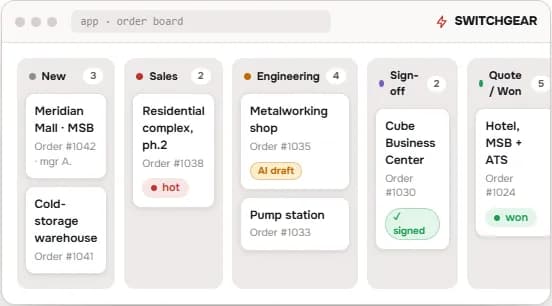
For the panel maker in Quoted by hand. Then not., that meant three weeks to production on the client's own server. The ERP stayed.
Cost calculator
Related: CPQ software or a quoting system built around your rules? · Buying software without a six-month risk
Switchgear manufacturer (name under NDA) · Low-voltage electrical panels · Italy
2 days
to a priced quote, instead of about 10
3 weeks
Everything waits for one person.
Thirty minutes. You describe the pain and the result you want. We ask questions. If we can help, you get one email with what we found, what we'd build and what it costs. If we can't, we'll say so.