Switchgear manufacturer (name under NDA) · Low-voltage electrical panels · Italy
2 days
to a priced quote, instead of about 10
Quoted by hand. Then not.
3 weeks
UnblockSee the business

Unblock
Software can read a specification and propose a bill of materials. It should never send a quote on its own.
Most quotes in make-to-order manufacturing start with a file, not a form. A PDF specification. A DWG single-line diagram. Sometimes a photo of a hand-marked drawing. Someone has to read it, turn it into a list of components and price that list.
Reading is the slow part. 83% of engineers already spend four or more hours a week on procurement tasks (Fictiv, 2026). Reading incoming drawings for quotes comes on top.
Software can now do a good share of that reading. Here is how we built it for a panel maker, what it does well, and where the line is.
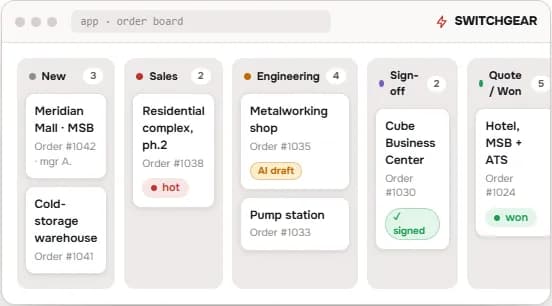
The flow in Quoted by hand. Then not. has five steps.
Then the engineer reviews the draft line by line and confirms it. Nothing reaches the client unchecked.
A drawing assistant is only as good as what it matches against. The client's price list was an 85 MB spreadsheet with 20 sheets and hundreds of images. No software can match reliably against that.
So the first two weeks went into structure. We imported the price list into a catalogue of 1,887 items organised into 223 analog groups by function, type, poles, rating and breaking capacity. Each category carries a risk flag: where a cheaper alternative is acceptable and where it isn't. The price difference between analogs is visible in the component card.
The drawing assistant arrived in week three. Building it first would have produced confident drafts against a messy list, which is worse than no drafts at all.
1,887
Clients ask about it on the first call, and they are right to. The obligations depend on how the system is classified. We build so they are met by design: we classify the risk, log every proposal the system makes, document the data it uses and keep a person in charge of the outcome. The client receives the technical file with the system, so their legal team has answers before it asks.
Before: the engineer read every drawing, searched the price list, chose analogs from memory and passed the list to the director for pricing.
After: the engineer opens a priced draft with reasons attached, checks the lines that matter, changes what's wrong and confirms. The director sees the assistant's usage statistics on the dashboard.
A priced quote now takes about two days instead of ten. The engineer reviews rather than reads.
Cost calculator
It is worth looking at if three things are true: requests arrive as files rather than forms, the same component families appear again and again, and one or two people do all the reading. If your requests are already structured forms, you need the formula and the catalogue, not the reader.
Related: Why your quotes take ten days · CPQ software or a quoting system built around your rules?
Switchgear manufacturer (name under NDA) · Low-voltage electrical panels · Italy
2 days
to a priced quote, instead of about 10
3 weeks
Everything waits for one person.
Thirty minutes. You describe the pain and the result you want. We ask questions. If we can help, you get one email with what we found, what we'd build and what it costs. If we can't, we'll say so.