Skip to content
Thnkers

Unblock

Buying software without a six-month risk: research, a pilot in days, then small steps

An error found on day one costs one unit to fix. Found after launch, it costs up to a thousand. How to buy accordingly.

The traditional way to buy business software is to write a long specification, sign a contract for the whole thing and wait. Six months later you find out whether it fits. If it doesn't, most of the money is gone.

There is a better way, and the evidence for it is old and solid.

Errors get expensive fast

NASA compiled studies on what it costs to fix a requirements error at each stage of a project (NASA, 2010).

1× → 100×+

cost to fix a requirements error: 1× at requirements, 5–7× at design, 50–177× at testing, 100–1,000× in operationNASA, 2010

The lesson isn't "write a longer specification". People rarely know what they need until they see something working. The lesson is to see something working early.

Why small steps win

  • Small projects succeed 10 to 30 times more often than large ones. Satisfaction and value are higher when far fewer features are delivered than planned (Standish CHAOS, 2015).
  • A six-month delay can turn a tenfold return into a four- or fivefold one (BCG, 2024).
  • Bain describes a manufacturer that piloted on one product in one country before scaling. The first year saved more than $10 million, and work ran five times faster (Bain).

The effect still takes time to build. Among manufacturing leaders in the WEF's Global Lighthouse Network, returns appear after 10 to 20 months (WEF, 2025). A pilot doesn't make the payoff instant. It makes it likelier.

An outside view helps

The UK's Made Smarter programme sends external specialists into manufacturers to diagnose, plan and support a first project. Its independent evaluation found that 84% of participants progressed their digital roadmap and more than 80% became better at choosing suppliers (Ipsos for DBT, 2025). An earlier pilot was associated with 6.5% higher revenue growth than a control group (Cambridge CIIP).

The value isn't the outsider's cleverness. It is the questions nobody inside has time to ask.

How a good process runs

  1. A 30-minute call. You describe the pain and the result you want. You don't need a specification.
  2. Research. The people who will build the system ask the questions: about the process, the data, the exceptions, the people.
  3. One email. What we found, what we'd build first, how it pays for itself and what it costs.
  4. A pilot in days. On real work, with the people who will use it.
  5. The system in weeks. In small steps, each with one number to move.

For the panel maker in Quoted by hand. Then not., week one delivered the database, the pricing core and the order board with roles. Week two delivered the full catalogue and the quote documents. Week three delivered the drawing assistant, the dashboard and deployment on the client's own server. Each week ended with something the team could use.

What to ask for before you sign

  • A measurable goal per stage. Hours saved, requests answered, days to quote.
  • Ownership. The code and the data are yours, with documentation.
  • An exit. What happens if you stop.
  • Support by the people who built it. Most of the lifetime cost of software is running it.
  • A payment model that shares the risk. Nearly 80% of B2B customers say a performance guarantee is key to their loyalty (McKinsey, 2022). On a subscription with us, payment starts after launch.

Related: Most digital projects miss their goal · Build or buy? A checklist for mid-sized companies

Questions

What is a software pilot?
A small working version of the system, used on real work by the people who will use the full system. It tests whether the approach fits before the full build.
How long should a pilot take?
Days, not months. Long enough to run real cases, short enough that a wrong assumption costs little.
What should a software contract include?
Ownership of code and data, documentation, a clear exit, a support arrangement and a measurable goal for each stage.

From the portfolio

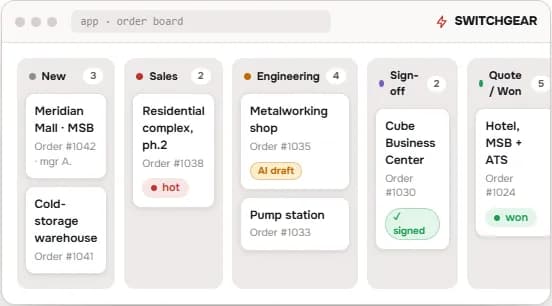
The Switchgear quoting app: a kanban order board with New, Sales, Engineering, Sign-off and Quote/Won columns.

Switchgear manufacturer (name under NDA) · Low-voltage electrical panels · Italy

2 days

to a priced quote, instead of about 10

Quoted by hand. Then not.

3 weeks

UnblockSee the business

Related goal

Unblock

Everything waits for one person.

One email a month. What we found, what we built, what it changed.

Tell us what's missing.

Thirty minutes. You describe the pain and the result you want. We ask questions. If we can help, you get one email with what we found, what we'd build and what it costs. If we can't, we'll say so.

or write to will@thnkers.com

Not ready to talk? See what the current way costs you