Switchgear manufacturer (name under NDA) · Low-voltage electrical panels · Italy
2 days
to a priced quote, instead of about 10
Quoted by hand. Then not.
3 weeks
UnblockSee the business

See the business
Nine in ten audited business spreadsheets contained serious errors. When a spreadsheet is fine, and when it has become the system.
Almost every company we work with has one spreadsheet that the business depends on. A price list. An order tracker. A payment register. Someone built it years ago, it grew, and now nobody wants to touch the formulas.
Spreadsheets are excellent tools. They are poor systems. The difference matters because of what the audits found.
91%
These are not careless people. Spreadsheets have no structure that prevents errors: no types, no permissions, no history of who changed what, and formulas that quietly break when a row is inserted.
Three or more, and the spreadsheet is no longer a tool. It's an unprotected database.
The panel maker in Quoted by hand. Then not. had an 85 MB price list: 20 sheets, hundreds of images, no structure. The engineer quoted from it. The director applied markups from memory. Nobody could say which version was current.
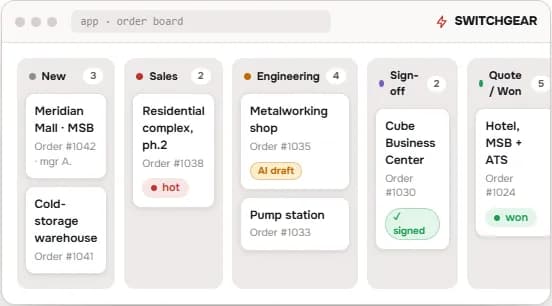
We imported it into a catalogue of 1,887 items in 223 analog groups by function, type, poles, rating and breaking capacity. Each category has a risk flag. The pricing formula runs through every order the same way. Every stage change is logged.
Quotes still export to Excel. The spreadsheet became an output, not the source.
In Italy the gap between small and large companies is wide. 41.9% of SMEs analyse their data, against 83.6% of large companies (Istat, 2025). Across the EU, 11.5% of small companies use business intelligence, against 69.2% of large ones (Eurostat, 2025).
When Italian SMEs do move their core processes into management software, the reported effects are large: 83% gained control over their processes, 80% saw fewer errors and 48% saw profitability rise (Osservatori Politecnico di Milano). These are self-reported survey results, not measurements, but the pattern is consistent.
You don't need to replace every spreadsheet. Move the ones that pass the five-sign test, in this order:
Keep spreadsheets for analysis, forecasts and one-off work. That is what they're good at.
Cost calculator
Ask the person who maintains your most important spreadsheet two questions. Which formulas would you be nervous to change? Who else could fix them if they broke? The answers tell you how much risk the business is carrying in one file.
Related: Four systems, none of them agree · When the engineer is on holiday, the company stops quoting
Switchgear manufacturer (name under NDA) · Low-voltage electrical panels · Italy
2 days
to a priced quote, instead of about 10
3 weeks
Four systems. None of them agree.
Thirty minutes. You describe the pain and the result you want. We ask questions. If we can help, you get one email with what we found, what we'd build and what it costs. If we can't, we'll say so.