Talents Music School · Music education · Minneapolis, USA
0
manual payment calculations across 2 locations
They asked for a payment button. We looked at what they actually had.
Run it yourselfUnblock

Run it yourself
Most CRMs describe an average business. Yours isn't one. A ten-minute test and what to do with the result.
Most companies we meet already have a CRM. They pay for it every month. The team keeps a spreadsheet next to it, and the director still asks people where a deal stands.
This is more common than vendors admit. Across the EU, only 28.5% of enterprises use CRM software, and 24.7% of small ones (Eurostat, 2025). Among those that do, many use a fraction of it. A vendor study puts unused SaaS licences at 36% on average (Zylo, 2026).
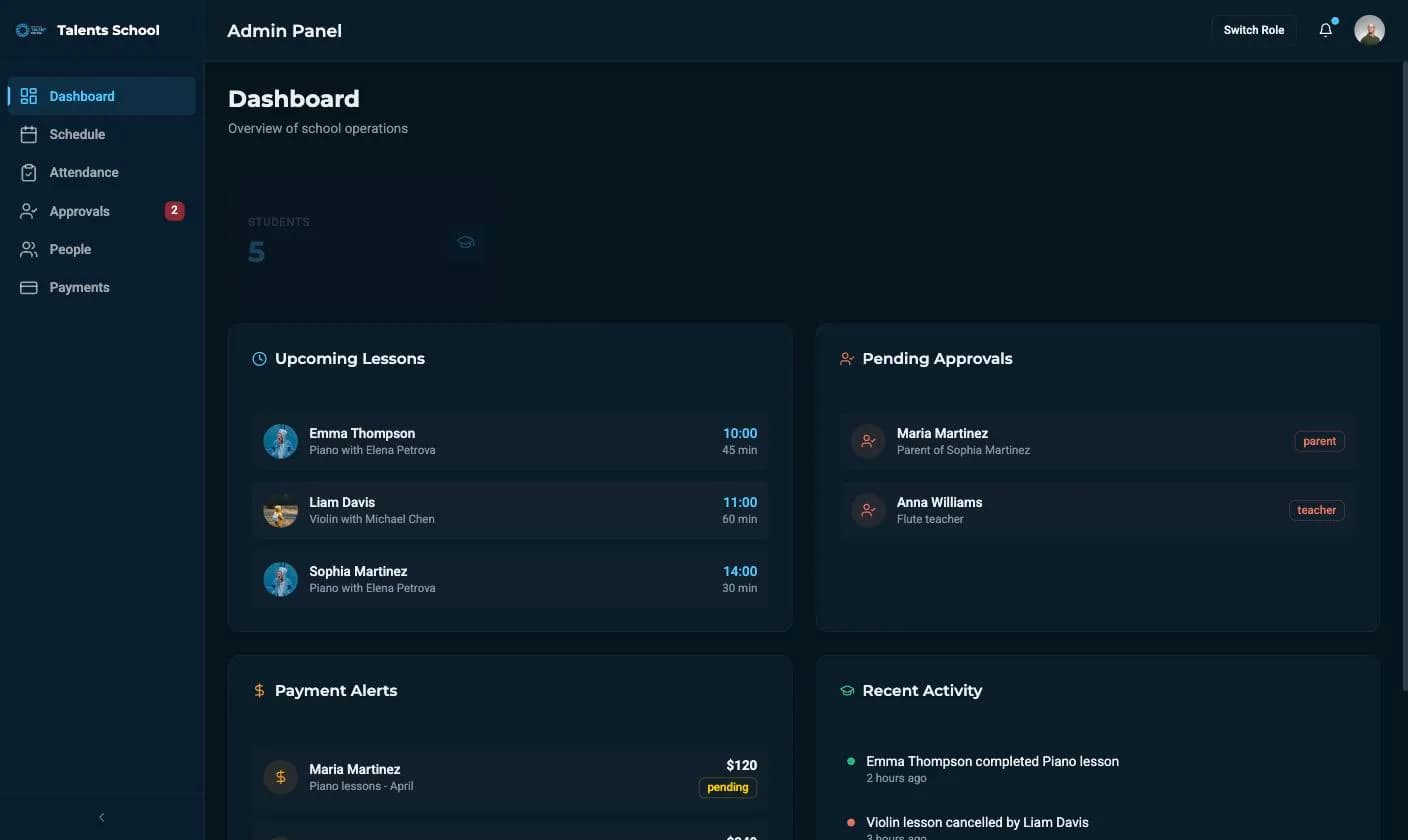
A music school in Minneapolis came to us asking for online payments. Before building anything, we looked at the CRM it was using. The platform had been built for something like a gym or a clinic, where clients come on fixed schedules, pay regular amounts and rarely cancel. A music school isn't that. Most lessons are private and one-on-one, and the schedule moves constantly. The platform couldn't handle it, so the director did it by hand.
When we went through the data, most of it wasn't useful. Fields nobody ever read. Categories that didn't match how the school thought about its students. Structures imported wholesale from a template. The school wasn't describing itself in its own system. It was describing itself in someone else's system, badly.
That is the usual reason a CRM goes unused. Not lazy staff. A system that makes the real work slower.
Open your CRM and answer these questions for the last 30 days.
If fewer than a third of the fields are used, and the end-of-month number comes from a spreadsheet, the CRM is not your system. It's a cost.
The music school. We went through the data with the director and kept only what was actually used: the fields people checked, the reports they ran, the numbers that mattered at month end. The rest went. The new system is built around students, teachers and lessons, with payments tied to each lesson. Three roles — administrator, teacher, parent — each see their own screen. One off-the-shelf subscription was cancelled. See They asked for a payment button.
The panel maker. The company already had a CRM. Once the quoting system we built was running, we added CRM functions to the same platform. Nobody was told to switch. The team moved to the new system on their own, because it was easier to work in. See Quoted by hand. Then not.
0
Bain found that around 65% of change initiatives require employees to change how they behave (Bain). Training doesn't make people change behaviour. A tool that saves them time does.
That suggests three rules:
Cost calculator
If the test shows a few unused fields, reconfigure. If it shows the real work happening elsewhere, the question isn't which CRM to buy next. It is what your process actually is. Write that down first. The software decision becomes obvious afterwards.
Related: Why we said no to the payment button · Build or buy? A checklist for mid-sized companies
Talents Music School · Music education · Minneapolis, USA
0
manual payment calculations across 2 locations
You run it by hand, and you're the bottleneck.
Thirty minutes. You describe the pain and the result you want. We ask questions. If we can help, you get one email with what we found, what we'd build and what it costs. If we can't, we'll say so.